

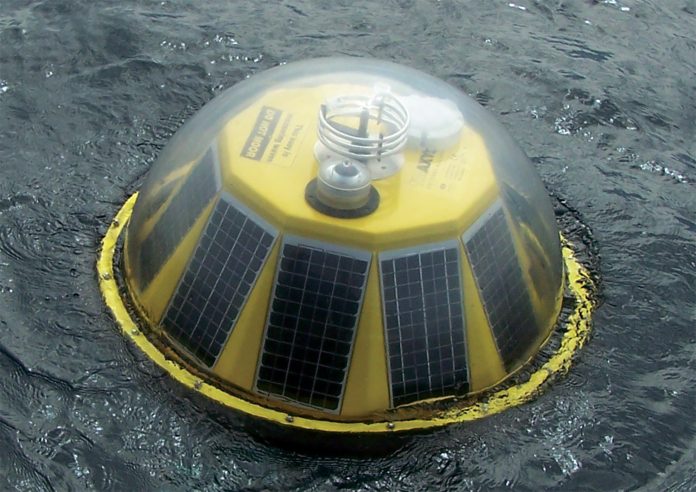
The Fisheries and Marine Institute of Memorial University of Newfoundland’s Centre for Applied Ocean Technology (CTec) is marking 20 years since the first deployment of what has become a vital ocean observation system that provides real time information to the marine community in three Atlantic provinces, as well as Northern Canada.
“The 20-year anniversary is a big milestone,” said Eric Davis, Senior Project Technologist for CTec.
“We started in August 2006. The first buoy deployment was in the mouth of Placentia Bay. Sensors got better over the years and we kept upgrading as we moved along. Some of the buoys activated over the years are no longer active. Some are still in place. Some are being readied to be upgraded or replaced. We’ve had several renditions of different types of buoys, different types of sensors, depending on what the client needs. They might say they need this kind of sensor on a buoy and we see if we can accommodate them. Get out there and work with them to see what we can do,” said Davis.
Smart Atlantic originally began as SmartBay, an environmental monitoring demonstration project in Placentia Bay in 2005 with the goal of creating awareness of the importance of better observing the marine environment. Today, it is the largest ocean observation system in eastern Canada and an example of industry working in partnership with the academic community.
Approximately 10 years ago, CTec expanded its SmartBay ocean observation platforms into Nova Scotia and New Brunswick in partnership with the Centre for Ocean Ventures and Entrepreneurship (COVE) of Halifax, forming the SmartAtlantic Alliance and creating the nucleus of a cooperative Atlantic Canada applied ocean observation capacity.
COVE, under the guidance of the Canadian Marine Pilots’ Association (Atlantic region), leads the operation of meteorological/oceanographic buoys off Herring Cove at the mouth of Halifax harbour in Nova Scotia and off the Port of Saint John, New Brunswick.
In 2016, the network further expanded to be national in scope with the establishment of a partnership between the Marine Institute and Ocean Networks Canada, an initiative of the University of Victoria in British Columbia, establishing Smart Atlantic as the east code node of ONC’s national observatory.
The data generated from the buoys is available to anyone free of charge through the SmartAtlantic website (www.SmartAtlantic.ca).
Davis said historical data and current data is available through the website. “If the buoy is recording and reporting it can be accessed.
“We’ve had infrastructure around the island at various times. 20 years gives us a big operating window. We’ve recently had infrastructure in Nova Scotia, New Brunswick, Conception Bay, Placentia Bay, Port aux Basques, Bay of Islands, Hermitage Bay, Notre Dame Bay, Bonavista Bay and off St. John’s,” he said.
Smart Atlantic has developed working partners to support this all-data stream, said Davis. “It’s part of a caveat. If we support an organization, we help you with buoys, sensors, whatever, you allow us to publish the data open access.”
CTec recently deployed a subsea observatory to monitor the waters of Placentia Bay. The reef ball initiative is a marine habitat offset and restoration effort conducted in conjunction with the Marine Institute that has deployed concrete reef balls and layer-cake structures using precise spacing calculations to mitigate habitat effects from industrial and vessel activity.
“We’re also planning an enhanced observation system close to our base in Holyrood/Conception Bay at MI’s ocean innovation centre, The Launch, as a part of our work to establish MI’s Marine Autonomous Test Zone (MATZ) here. We will deploy buoys for situational awareness, weather, waves etc., to support clients testing their technology in this zone. We’re also planning to deploy a full weather buoy out at the head of our test zone as well as a wave rider buoy on the eastern side of our test zone. We hope to have these assets in place by end of year,” Davis said.
CTec, in conjunction with its industry partners, is also doing work in Canada’s Arctic.
“We have weather stations equipped with AIS (Automated Identification System) receivers that remotely report weather information and any vessel traffic data through a satellite link. With the ever-changing Arctic water conditions becoming more navigable, the monitoring of vessels equipped with AIS transponders is key to see where they may be encroaching upon any wildlife protected areas/zones,” said Davis.
“SmartAtlantic has to be one of the most successful applied research initiatives in MI history, 20 years and counting. We’re always open to any industry partners that would like to come seek our assistance,” Davis added.
SmartAtlantic is also a data provider and regional partner that feeds its meteorological and oceanographic data into the Canadian Integrated Ocean Observing System (CIOOS) Atlantic data catalog, making its coastal buoy and observation datasets openly accessible through the broader national network.


