

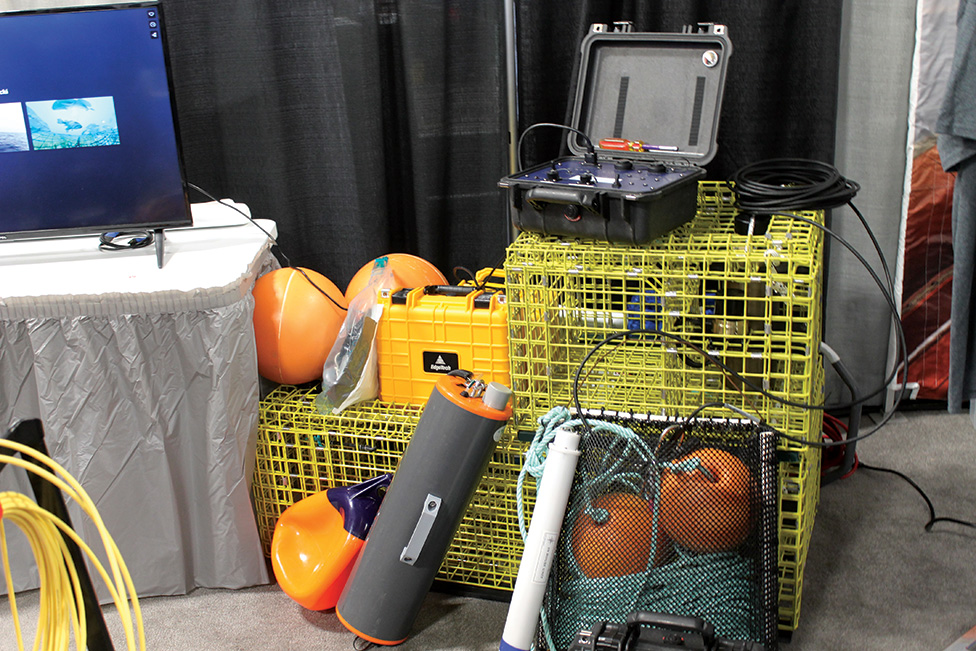
Above photo: According to the Woods Hole Oceanographic Organization, fishing gear entanglements account for 82 per cent of all North Atlantic right whale mortalities. By removing rope from the water column these whales inhabit, ropeless gear manufacturers hope to reduce the incidents. Photos by Nick Travis
The Canadian Centre for Fisheries Innovation (CCFI) has done further work in assessing the viability of ropeless fishing gear in Newfoundland and Labrador, but the technology has still fallen short.
Ropeless gear, also known as rope on command (ROC) gear, is a fisheries technology wherein a typical trap or pot is set on the ocean floor but lacks a vertical line and buoy.
These components, instead, are stored within the gear and are released when a signal, which is usually based on acoustics, tells the gear to resurface. In lacking a vertical line and buoy, ROC gear allows for marine mammals like the North American right whale to pass by areas where gear is set without the risk of getting entangled.
In 2023, CCFI worked alongside Nova Scotia-based Ashored Innovations to test the viability of their ROC gear in the Newfoundland and Labrador crab fishery. Some issues were found, such as the size and weight of the gear, the upfront cost of the equipment and locating the gear after it had been dropped on the seafloor. Other issues presented to Ashored were remedied to suit the N.L. fishery, like their system not initially withstanding the water pressure seen at the increased depths required to fish snow crab. Overall, the CCFI concluded that ROC technology needed work before being suitable for use off the coast of Newfoundland and Labrador.
Going back to the drawing board, CCFI has begun a collaboration with Rimouski, Québec-based Devocean. Compared to Ashored, Devocean’s system is cheaper, lighter and features a deck unit that allows harvesters to automatically rewind the rope used in the trap, saving time and avoiding potentially dangerous accumulations of rope on the deck of the fishing vessel.
“They both have the acoustic release, as all [ROC units] do. The Ashored model is a separate cage unit with the rope in it and a buoy system that when the acoustic release is sent, the cover comes off, the buoys are released and the rope comes to the surface. That unit comes aboard, and your strings of pots are attached to that,” said Keith Hutchings, Managing Director of the CCFI.
“The Devocean unit is a coiling unit that basically attaches to the deck of the ship. It’s a buoy unit with a coil on it that releases and comes to the surface, and you would attach that to the top of the first crab pot.”
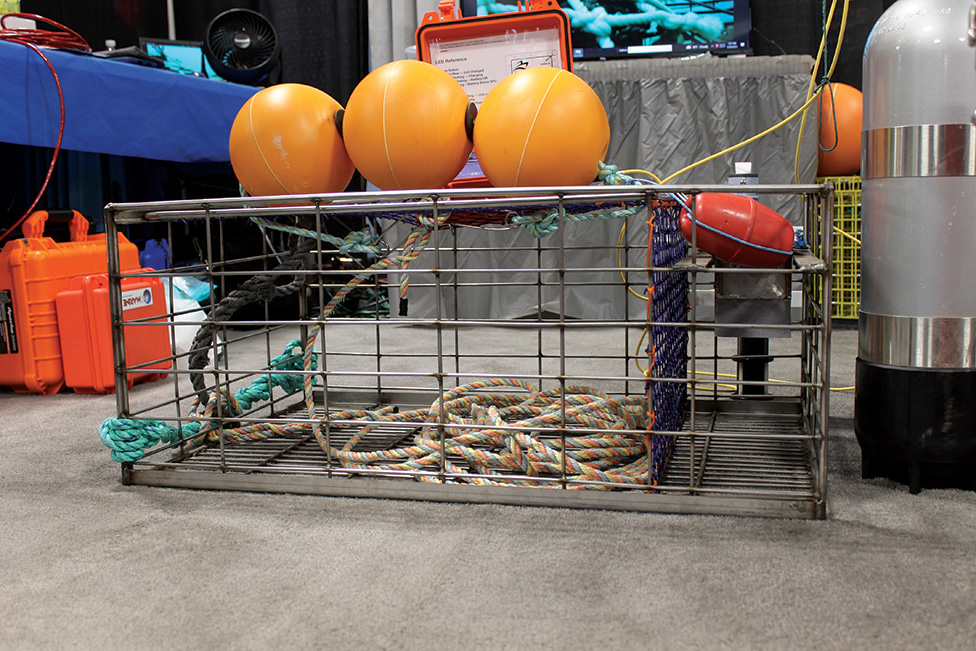
Using many of the same parameters CCFI utilized in testing Ashored gear, Devocean’s model was tested by CCFI alongside a harvester from Bay de Verde, N.L.
Much like an initial issue seen in Ashored’s testing, Devocean units could not withstand the water pressure seen at 300 metres deep. While CCFI has not finished their trials with Devocean’s ROC units, the company has not yet been able to get their gear functioning at the same depths as Ashored Innovations.
“We started at 300 metres, because that’s where we wanted to get to with Devocean, because that’s where we had gotten to with Ashored,” said Hutchings. “We had some trouble initially, so we had to pull back from 300 metres; did some inshore testing at 100 metres closer to shore, and then we were more concentrated on the functionality of the unit and not so much worried about depth.”
One place Hutchings said Devocean’s gear shined, however, was its smaller design and their rope coiling deck unit, both of which save space on the decks of fishing vessels.
“The actual space required compared to the Ashored model, which uses large cages and a lot of rope, is probably going to take up more space than the Devocean unit,” said Hutchings. “The [Ashored] units that hold the rope for bigger depths can be 180 pounds. That’s a unit that you need to take off, get it in the water and get it back out of the water.”
However, CCFI and Devocean are not done collaborating.
Hutchings noted that the company has plans to return to the province in November 2024 for further trials. But, with two companies trialled so far, Hutchings said there is a lot of work to do before ropeless gear becomes viable off the coast of Newfoundland and Labrador.
“It is working in places, but to the degree and extent that we’d need to have it operate and be efficient and effective here in Newfoundland and Labrador; with this unit, we didn’t see it at that level. Not yet,” said Hutchings.
Hutchings is of the opinion that ROC gear is heading in the right direction to be viable in N.L. waters, but more research and development will be required. Part of the solution according to him, is further funding from the government to aid in these efforts. Until the technology advances to the point where it is applicable in all fisheries, he said that the government should look at approving the use of gear based on areas where the risk of entanglement with marine mammals is higher instead of trying to apply the gear in a broader sense.
“In Moncton, we had a discussion. It was about — Why don’t we start doing a risk assessment? In areas where there is prevalence of right whales, season by season, we want to focus on those areas for whatever depth that we have units that can be used that would continue to allow harvesters to fish in a closed area,” said Hutchings. “Instead of this broad-based approach where everybody in Québec and Atlantic Canada and Newfoundland is included where we have to come up with this overall system for different fisheries at different depths, different conditions and different vessels. I thought that was very forward-thinking.”


