


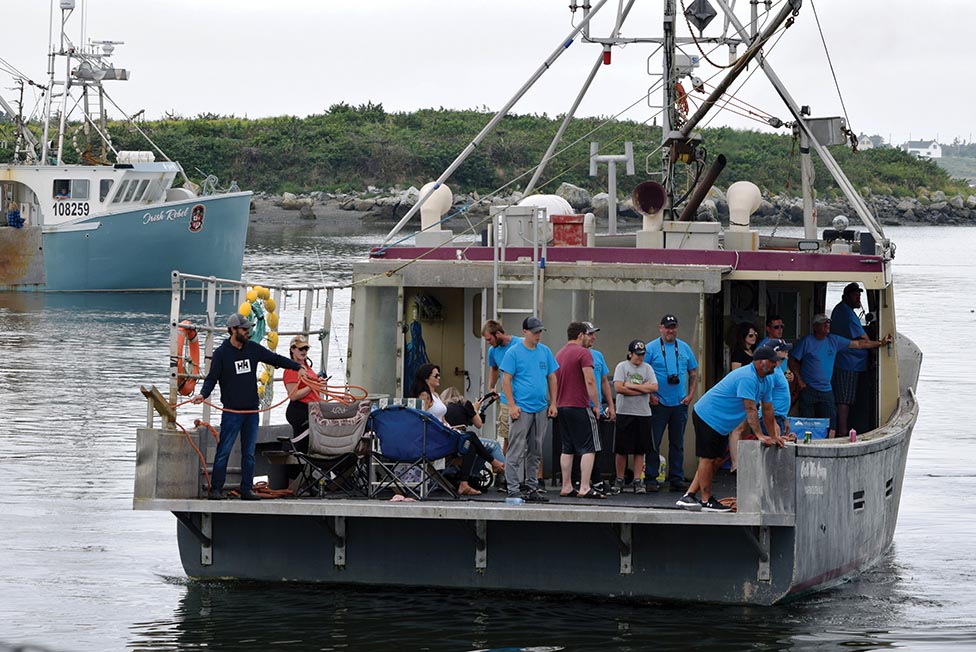
The Yarmouth Shark Scramble was back on deck, COVID-19 style, for 2021, attracting 14 boats and 115 participants for the 23rd annual tournament that ran from Aug. 18 to 21.
Each boat was allowed to land three blue sharks of a minimum length of eight feet. Smaller blue sharks caught were tagged and released.
“It was a good all-around tournament,” said Bob Gavel, Scramble co-founder. “The fishermen were extremely happy to be going… We had a good response on sponsorships. Without the sponsors, the scramble wouldn’t be able to take place. Everybody was very excited to be taking part in it.”
The grand prize winner in this year’s Scramble was Shane Lynk aboard the Lurcher Shoal. Lynk won a Kawasaki 50cc children’s ATV donated by Tri-County Tractor and the Yarmouth Shark Scramble.

Cody Titus aboard Roy’s Boy took first place for the largest shark with a 438-pound catch. In second place was Jacques Surette aboard the Pull N’ Prey (385 pounds). Christian Deveau from the Irvin John was third (332 pounds).
The vessel Roy’s Boy, captained by Chad Graham, received the award for High Boat Average (329.3 pounds). Fifteen-year-old Deanne Doucette aboard the Acadian Star received the Up-and-Coming Sharker award for her 280-pound catch.
The Yarmouth Shark Scramble was one of two recreational shark fishing tournaments in southwestern Nova Scotia this past summer. The Lockeport Sea Derby was also held in August, after a year’s absence due to COVID-19. The Yarmouth Shark Scramble was also cancelled last summer.
Recreational fishing tournaments such as these not only provide samples and data for scientists and researchers to compile and study, but also offer the opportunity to get some of the animals tagged, said federal Fisheries and Oceans Canada shark researcher Warren Joyce, who works in the shark unit at the Bedford Institute of Oceanography (BIO).
“One of our main focuses of the tournament as in past years is distributing tagging kits,” said Joyce. “I hand them out at the captain meetings for the fishermen to tag any undersized sharks released alive… if it gets re-captured, we can find out where the shark went, how long it has been out there, how big its grown over that time. We can get some movement and migration information, exploitation rates when the sharks are being captured. Commercial fisheries routinely capture tagged sharks as well as recreational fisheries. It is important information for us.”
Since the tagging program was implemented in 2006, tournament fishermen in Nova Scotia have tagged over 2,000 sharks, said Joyce, including all tournaments held in the province. In 2019, a total of 164 sharks were tagged, 162 in 2018, and 127 in 2017. Joyce estimated between 100 to 140 sharks were tagged at this year’s Yarmouth Shark Scramble.
Not a huge number of the sharks have been recaught since the tagging program began, said Joyce, somewhere between 60 and 70. “It works out to about four per cent which is a pretty reasonable number if you’re looking at a tagging program.”
For DFO shark researchers, the sharks landed during the recreational tournaments provide data such as length, weight and sex of the animals. “We go down with a team and collect the morphometrics when the sharks are landed,” said Joyce. It’s not just us looking for information of these sharks that are landed. Most scientists don’t have easy access to sharks and sometimes use samples” in their research.

One of the groups at this year’s Shark Scramble was the Dalhousie Agricultural College which was looking at stomach contents, vertebrae for aging purposes, collecting bacteria from intestines to look at different bacteria and collecting hearts for a study being done in Quebec, said Joyce.
At the Lockeport Sea Derby, the Oceanographic Environmental Research Society was collecting samples. “They have a lab in Comeauville and are actually studying the heavy metal concentration in blue shark,” said Joyce. The study was started in 2014.
Blue sharks are caught as a bycatch in the tuna and swordfish fisheries. “We have observers that go and collect data from those trips but as far as we know it’s not endangered. It’s one of the most populous and prolific large sharks we have in Canadian waters” that can have up to 50 pups a year, compared to a porbeagle shark which only has three to five.
Since 2018, only blue sharks are allowed to be landed at recreational shark and ocean fishing derbies.


